Fiberglass (GRP)
Glass-fiber cloth laid up in resin inside a female mold, perhaps the most common way production boats are built.1,2
- Hulls on record
- 8
- Builders
- 1
- Built between
- 2013–2026
On the recordHulls by decade built
What it is
Fiberglass is fiber-reinforced plastic: layers of glass cloth bonded with polyester, vinylester or epoxy resin. It caught on in the 1960s and is now perhaps the most common way production boats are built.1
It came into its own on lower production costs. In sportfishing, the Hatteras name went on to dominate the fiberglass market for decades.3,4
How it's built
Most production hulls are laid up in a female mold. A release agent goes on first, then gelcoat, the glossy outer finish, 12 to 22 mils thick. Alternating layers of glass cloth and catalyzed resin follow to build the laminate.1,2
A core of balsa, marine plywood or foam can add strength without more heavy glass, typically in the transom, topsides or deck. Even a solid-glass hull relies on stringers and bulkheads to keep the laminate from flexing.1,2
What it's good for
Fiberglass is relatively low in maintenance, high in strength and easy to repair, and it generally costs less than other boatbuilding materials.1
Trade-offs
BuildersOn record with Fiberglass (GRP)
- Viking8 hulls
Hulls with Fiberglass (GRP)
8 hulls · All construction
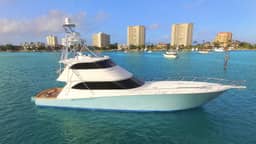 Panacea3 names since 2013Viking hull 82-019 · 82 Enclosed Bridge201371.6 ft
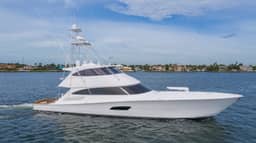 Astrikos3 names since 2016Viking hull 92-104 · 92 Enclosed Bridge201677.9 ft
- Double BarrelViking hull 92-114 · 92 Enclosed Bridge201779 ft
 The Experience2 names since 2019Viking hull 80-726 · 80201967.8 ft
- Krazy SaltsViking hull 80-732 · 80202067.8 ft
- Cookie MonsterViking hull 90-810 · 90202476.8 ft
- SafariViking hull 82-209 · 82 Convertible202682.6 ft
- HoorayViking hull 82-210 · 82 Convertible202668.5 ft
Sources
- 1Boatbuilding Basics: Fiberglass, Composites, and WoodPropTalk
- 2Gelcoat Blisters: Diagnosis, Repair & PreventionGougeon Brothers (WEST SYSTEM)
- 3The Gougeon Brothers on Boat Construction: Wood and WEST SYSTEM Materials, 5th EditionGougeon Brothers (WEST SYSTEM)
- 4Knit Wits, the first HatterasSoundings
Each hull’s construction is shown on her page as her source wrote it. Know of one we’ve missed? Send us what you have.